A lesson using Sheep in a Jeep by Nancy Shaw, focusing on rhyming words.
Page Contents
Background Info
Shared Readings
Teaching Skills with Familiar Text
Rhyming Activities (includes a sheep reproducible)
Integrating Other Curricular Areas
Other Submitted Ideas
Background Info for the Teacher
These are the activities I did with my kindergarten class. We had just started focusing on rhyming words, and this book really helped it sink in for kids who were having trouble with the concept.
The kids LOVE this book. It meets every standard of a great shared reading text: it’s funny, packed with rhyming and predictable text, and has rich illustrations. Even with the very first reading, the kids can complete some of the sentences. And after reading it several times, they never say, “Oh, why are we reading THAT book again??”
Shared Readings
You’ll need the big book edition for shared reading.
Before the First Reading
We examined the cover of the book and the children noted the road, grass, jeep, sheep, etc. We took a picture walk—looking through the illustrations and discussing what they saw happening. Then we read through the book without interruption… except for kids pointing out funny details like the pigs’ tattoos. 🙂
Second Reading
We noticed that sheep and jeep rhyme! I challenged the class to listen for other rhyming words during this reading. We followed up with a rhyme chart (see below under Rhyming Activities).
Subsequent Readings
Since we focused on rhymes for more than one day while making our rhyme chart and sheep rhymes, I paused to let students fill in rhyming words as we read. After several readings, all I had to do was point to the words and the kids could read them.
Using Familiar Text to Teach Skills
Vocabulary:cheap, steep, steer
There were a few vocabulary words the kids didn’t know. We discussed the meanings of cheap, steep, and steer (as in — the driver forgot to steer!).
High-Frequency Word:in
On the last day, we went through the book page by page searching for the word in. I had 5–6 students come up to point out the words. However, I didn’t follow up with anything for the whole class, so most of them still don’t recognize it. Next time, I could copy parts of the text (onto sentence strips or in a kid-sized book) and have students highlight in. They could also find the word in magazines, etc.
Rhymes
Rhymes are abundant in this book! Read on for our rhyming activities.
Phonemic Awareness – Rhyming Activities
Make a Rhyme Chart
I wrote the word sheep and drew a picture of a sheep. The class volunteered words that rhyme with sheep. I separated -eep and -eap words by writing them in different columns. After writing the chart together, each student chose “eep/eap” words to copy on their sheep paper. Most wanted to write them all! They then read each word to me, using beginning sounds to help decode.
Make a Class Rhyming Book
Using the rhyme chart, we found rhyming words that could be put into short phrases or sentences about sheep. Many came right from the book, such as:
“Sheep leap.”
“Sheep sleep.”
“Sheep in a Jeep.”
You could create MANY more rhyming sentences, but we stuck with these three for our book of sheep rhymes.
Each child chose a sheep rhyme to write (using our chart), then illustrated it with construction paper, cotton balls, markers, etc. The artwork was adorable—especially the sheep sleeping in beds.
Share the Sheep Rhymes & Illustrations
The next day, when the pictures were dry, the kids shared their sheep rhymes by reading them to the class. The pages were displayed in the hallway and then bound into two classroom books (“Sheep Rhymes: Part 1” and “Part 2”). Because the cotton balls made the pages thick, I reinforced each page, punched a hole in the corner, and used a metal ring to bind them.
Make a Sheep Rhyme Manipulative
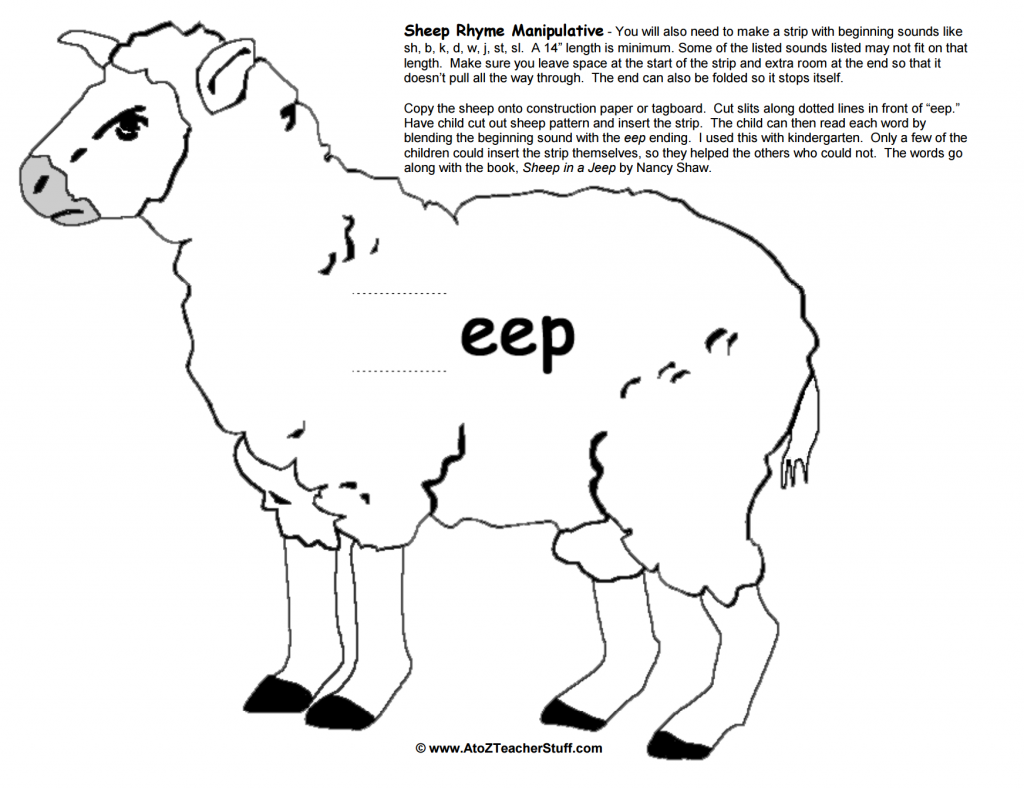
(Sheep reproducible included.) It may need to be enlarged after printing.
Letter-size paper: I reproduced several copies of a sheep showing a blank space plus “eep.” I used an X-Acto knife to cut slits where the blank space was.
Legal-size paper: I printed beginning sounds (sh, d, b, p, k, sl) for -eep words on long strips. I drew stop signs at both ends. (Side note: d, p, b = MAJOR confusion for most kids at this stage!)
Students inserted the strips through the slit, folded the ends, and practiced reading the words by sliding the strip to change the beginning sound. They loved reading the words to their parents at home!
Integrating Other Curricular Areas
Next year I hope to add more cross-curricular activities. We checked out a video from the library about real baby sheep—that was about it.
This book could easily tie into a theme on farm animals or a March theme (“comes in like a lion, goes out like a LAMB!”).
Other Submitted Ideas
From Connie
We use Sheep in a Shop to practice “sh.”
We write on the board: “Sheep in a __________________.” Children raise their hands and offer ideas. It is such fun.
Modifications have led to ideas like:
Sheep get the shivers.
Sheep get shaved.
Sheep in a shoe store.
Sheep shrink.
Since we have 6-, 7-, and 8-year-olds, we offer extension choices. Students can make a detailed poster, write a poem, or write a new version of the story. Our list grew to more than 40 ideas! Kids continue adding to it during exploration time, and lately have been seeking out the dictionary. 🙂 Connie
From Christine
I teach preschool special education. I have developed several activities centered around Sheep in a Jeep.
With our kids, the challenge is getting them to listen and focus on the pages, and maybe repeat key words. Nondisabled children might ask for a favorite book over 100 times, but our kids often lack the language to do so. For that reason, favorite books are read many times—and we need creative follow-up activities.
We extend the book by sitting kids in laundry baskets with cut-out steering wheels. We “drive” our jeeps and make driving sounds. We also practice concepts such as:
Get in the jeep
Get out of the jeep
Stand behind the jeep to push
And of course, the best part is when our jeeps “fall over” and we are sheep in a jeep in a heap.