In this activity, students discover how white light can be split into a rainbow of colors using everyday objects: a CD, a hair, and a feather. They’ll see that light doesn’t always travel in straight lines—on a tiny scale, it bends and creates patterns.
Objectives
Students will:
Observe rainbows produced by reflected light.
Explore diffraction—the bending and spreading of light around tiny objects.
Understand that repeated fine structures (like lines on a CD or barbs in a feather) can act as a diffraction grating.
Connect diffraction to real-world uses in science and technology.
Materials
For demonstrations or small groups:
1 CD or DVD (scratched/old is fine)
A flat surface in direct sunlight (or a strong flashlight as backup)
Lamp with a shade (or a bright desk lamp)
Aluminum foil
A single hair (human or pet)
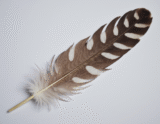
A feather (craft feather or clean bird feather)
Tape and a pin or toothpick (for making a tiny hole in foil)
Part 1 – Rainbow from a CD
1. Set Up
Place the CD label side down on a flat surface in direct sunlight.
Look at the ceiling or nearby wall where the reflected light lands.
2. Observe
You should see a curved rainbow pattern reflected from the CD. Ask students:
What colors can you see?
Does the pattern move if we move the CD?
What’s Happening?
A CD has tiny, evenly spaced tracks (millions of very fine lines). These lines act like a diffraction grating, bending and spreading white light into its component colors (red, orange, yellow, green, blue, violet).
Part 2 – Diffraction Around a Single Hair
Now we zoom in on a much smaller object: a hair.
1. Make a Pinpoint Light Source
Turn on a lamp.
Place a small piece of aluminum foil between your eyes and the bulb (for example, across the top of the lampshade).
Use a pin or toothpick to poke a tiny hole in the foil so only a small dot of light comes through.
2. Use the Hair
Hold a single hair 2–3 inches in front of your eye.
Look at the pinpoint of light through the hair.
Slowly move the hair side to side or closer/farther from your eye.
3. Observe
You should see:
A thin bright line or band crossing the pinpoint of light.
Sometimes faint fringe patterns or tiny repeated bright/dark areas.
You don’t actually see the hair sharply (it’s out of focus), but you do see the pattern created by light bending around it.
What’s Happening?
When light waves hit the hair:
They bend around the edges – this is called diffraction.
Bent waves interfere with each other, creating a pattern of bright and dark regions.
Even a single hair is large enough (compared to the wavelength of visible light) to create a visible diffraction pattern.
Part 3 – Rainbows Through a Feather
Now we move from one hair to many hair-like structures side by side.
1. Look Through the Feather
Hold the feather a few inches in front of your eye.
Look at the same pinpoint of light through a part of the feather where the barbs are close together.
Slowly tilt and move the feather.
2. Observe
With the right angle, you may see:
Rainbow-like bands or colors
Repeating colored lines or shimmering patterns
What’s Happening?
A feather has:
Many fine, parallel structures (barbs and barbules)
Because they are so closely spaced, they act as a diffraction grating
Light passing between these fine “lines”:
Is bent at slightly different angles depending on its wavelength (color)
This separation of colors makes rainbow bands appear.
This is the same physical principle that makes the CD’s rainbow, just with a natural structure instead of a man-made one.
Compare & Connect
Ask students:
How is the CD similar to the feather in terms of structure?
Where else have you seen rainbow effects? (soap bubbles, oil on water, some insect wings, holograms)
How is this different from a rainbow in the sky, which is caused by refraction in raindrops?
Real-World Applications
Diffraction gratings are used in:
Spectroscopes / spectrometers – to analyze the light from stars and determine their elements and temperature.
Chemistry labs – to identify chemicals based on the light they emit or absorb.
Security printing & holograms – on ID cards, money, and packaging.
CDs, DVDs, Blu-ray – the track spacing is based on the wavelength of laser light.
Extension Ideas
Have students draw what they see from:
the CD rainbow
the hair pattern
the feather colors
Use a flashlight in a dark room to reflect from the CD onto a wall if sunlight isn’t available.
Compare different feathers or synthetic mesh (like fine fabric) to see which create clearer color bands.