Spanish Calendar Time: Days of the Week & Counting Practice
Lesson 423 • By Christopher Murray (Expanded Version)
Grade Levels: K–2 (adaptable for 3–5)
Learning Objectives
Students will:
-
Learn and correctly pronounce the Spanish names of the days of the week.
-
Use Spanish question/response patterns to identify today, yesterday, and tomorrow.
-
Learn Spanish number words while counting the dates on the calendar.
-
Build daily listening, speaking, and memory skills through repetition.
-
Develop confidence in using Spanish outside of formal lesson time.
Materials
-
Classroom calendar (monthly pocket chart or wall calendar)
-
Pointer or stick (optional but fun!)
-
Day-of-the-week cards in Spanish (optional but recommended)
-
Number cards (optional)
Daily Calendar Routine (Plan)
Christopher’s approach is perfect—simple, natural, embedded in real classroom routines. Below is a polished, step-by-step version you can follow.
️ 1. Introduce the Days of the Week (Start of School Year)
Begin with the day of the week you are on.
Example: If it’s Monday, teach Lunes.
Use the word all day long:
-
“Today is lunes.”
-
“Put your homework folder in the bin for lunes.”
-
“Our line leader for lunes is….”
As each new day arrives, introduce the next word, until all siete días are learned.
Spanish Days of the Week:
| English | Spanish |
|---|---|
| Monday | Lunes |
| Tuesday | Martes |
| Wednesday | Miércoles |
| Thursday | Jueves |
| Friday | Viernes |
| Saturday | Sábado |
| Sunday | Domingo |
️ 2. Daily Question Routine (After All 7 Are Learned)
Once they know all the days, start the daily questioning ritual:
Teacher asks → Students answer:
-
¿Hoy es? (Today is?)
→ Hoy es lunes. -
¿Ayer fue? (Yesterday was?)
→ Ayer fue domingo. -
¿Mañana será? (Tomorrow will be?)
→ Mañana será martes.
This builds natural conversation patterns, not just vocabulary memorization.
Pro Tip: Rotate student helpers to lead the questioning.
3. Counting the Dates on the Calendar (Beginning of Any Month)
Start fresh with Day 1 of the new month.
Each day:
-
Point to the number.
-
Say it in Spanish.
-
Have students repeat.
-
Count from 1 up to today’s date in Spanish.
Example (on the 9th):
“Vamos a contar… uno, dos, tres… nueve.”
Students LOVE counting higher than needed—use it!
By year’s end, most students can count well past cien (100).
Optional Enhancements
1. Visual Cards
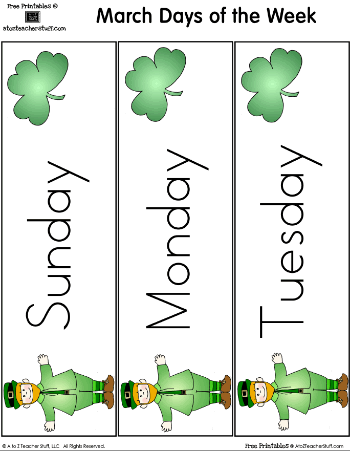
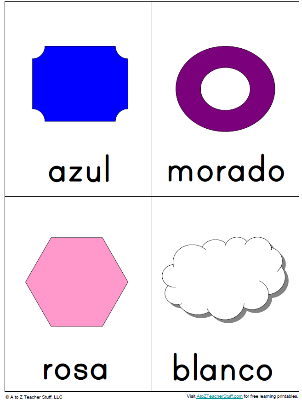
Use Spanish day-of-the-week cards with colors and icons to reinforce learning visually.
2. Movements for Each Day
Example:
-
Lunes → clap
-
Martes → stomp
-
Miércoles → jump
This helps kinesthetic learners.
3. Add Weather in Spanish
-
Hace sol (Sunny)
-
Está nublado (Cloudy)
-
Hace frío (Cold)
-
Hace calor (Hot)
Add: “¿Qué tiempo hace hoy?”
4. Add Months of the Year
Slowly introduce:
-
Enero
-
Febrero
-
Marzo
…etc.
5. Use Songs
There are many simple Spanish “Days of the Week” songs perfect for K–5.
Differentiation by Grade Level
Kindergarten
-
Focus on repeating words
-
Use visuals
-
Count to ~10–20 reliably
-
Lots of gestures and songs
1st–2nd Grade
-
Full sentences (Hoy es…, Ayer fue…)
-
Counting to 31–60
-
Simple written practice
-
Matching games (day → Spanish word)
3rd–5th Grade
-
Add spelling practice
-
Create weekly schedules in Spanish
-
Discuss before and after concepts (“¿Qué día viene después de jueves?”)
-
Counting to 100+
-
Mini-conversations in pairs:
→ “¿Qué día te gusta más?” “Me gusta viernes.”
Informal Assessment
Look for whether students can:
-
Say the day of the week in Spanish
-
Answer “Today/Yesterday/Tomorrow” questions
-
Count from 1 to today’s date
-
Recognize day words when written
-
Participate orally with confidence
Find More: