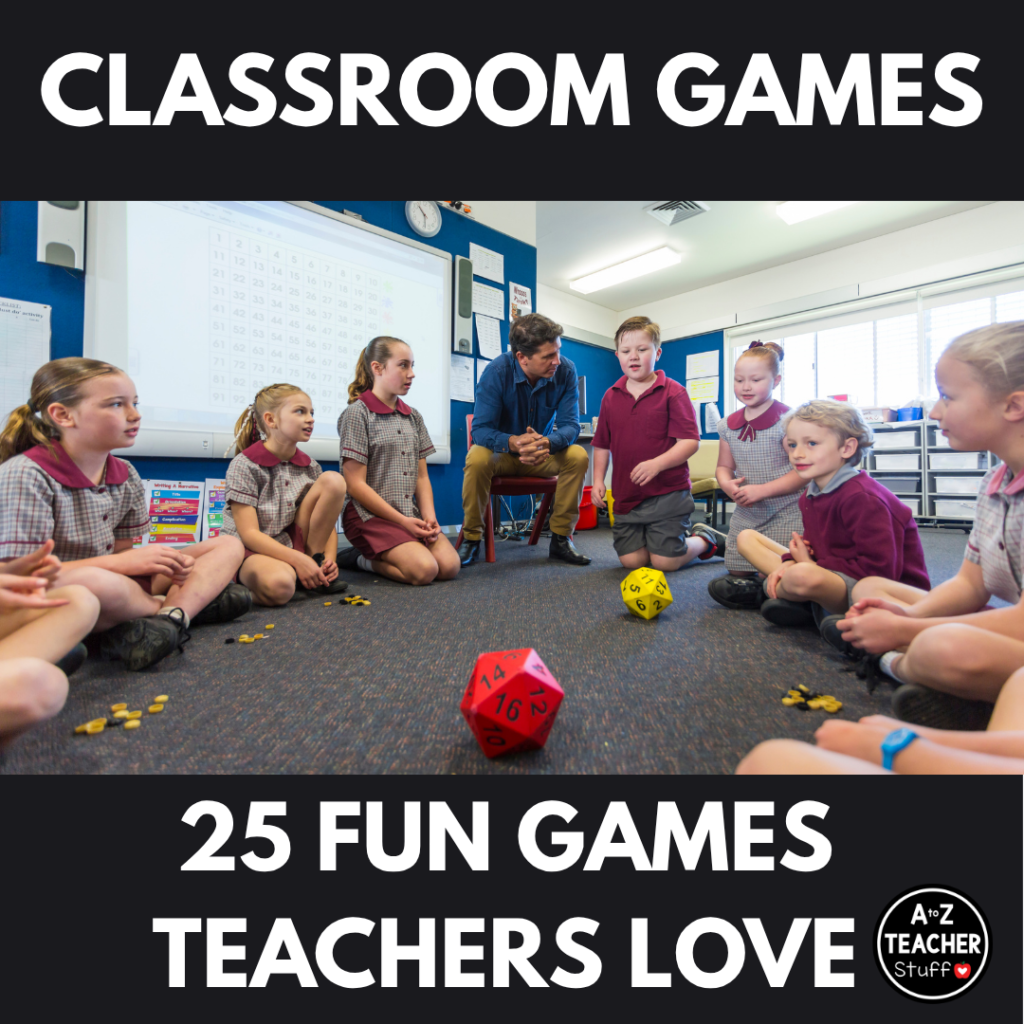
Looking for a new classroom game? Sometimes you just need something fun to review for a test, practice spelling words, or fill the last ten minutes of class.
Back in 2007, a teacher named Trina started a discussion in the A to Z Teacher Stuff forums asking other teachers to share their favorite classroom games. She was getting tired of the same old review activities and wanted some fresh ideas.
Teachers jumped in with all kinds of games. Some were old favorites, while others were games they’d made up or changed to fit their classes. They shared ideas for everything from preschool to middle school, and even a few that worked well with high school students.
We’ve gathered 25 of those classroom games here, along with instructions and ideas for using them with your own students.
Quick Classroom Games With Little or No Prep
These are good games to keep in mind when you have a few minutes to spare or need a quick change of pace.
1. Silent Ball
Best for: Elementary and middle school Materials: Small, soft ball
Silent Ball is a favorite when students need a little break but you still want to keep the noise level down.
How to play:
Have students stand in a circle.
Give one student a soft ball.
Students gently toss the ball to one another without talking.
If someone talks, drops a catchable ball, or makes a poor throw, that student sits down.
Continue until only one or two players remain.
One teacher shared that she played with students sitting on top of their desks. Another preferred having everyone stand in a circle. When only two players were left, she had them take a step backward after each successful catch.
Teacher tip: Clear a space in the classroom and use a lightweight ball. You can also skip elimination and challenge the class to complete a certain number of silent catches together.
2. Four Corners
Best for: Kindergarten through middle school Materials: None
Four Corners gets students moving and requires almost no preparation.
How to play:
Number the four corners of the classroom from 1 to 4.
Choose one student to stand at the front with their eyes closed.
Everyone else quietly chooses a corner.
The student at the front calls out a number.
Anyone standing in that corner is out for the round.
Continue until one student remains.
The winner becomes the next caller.
Make it educational: One teacher suggested labeling the corners A, B, C, and D instead. Ask a multiple-choice review question and have students move to the corner they think has the correct answer.
That turns a simple movement game into a quick review activity for almost any subject.
3. King or Queen of the Classroom
Best for: Upper elementary through middle school Materials: Review questions or a completed assignment
This game was one of Trina’s favorites. She originally used it to make grammar review more interesting and was surprised by how much her eighth graders enjoyed it.
How to play:
Have students complete a short review exercise.
Ask everyone to stand.
Go through the answers one at a time.
Students who answered incorrectly sit down.
The last student standing earns the title of King or Queen of that topic.
If you’re reviewing participles, for example, the winner becomes the King or Queen of Participles.
Trina drew a big crown on the chalkboard and wrote the winner’s name inside it. She said her students loved seeing their names on the board.
Another teacher tried the game with her own class and reported that her students were just as excited about being crowned.
Teacher tip: For a version that keeps everyone playing, let students track their correct answers and recognize everyone who reaches a certain score.
4. Five in Ten
Best for: Upper elementary through high school Materials: List of categories or topics
This is a quick thinking game that works well for vocabulary, grammar, social studies, and just about anything else students have been studying.
How to play:
Divide students into teams.
Give a student or team a category.
They have ten seconds to name five things that fit the category.
Try challenges like:
Name five state capitals.
Name five adjectives.
Name five mammals.
Name five multiples of six.
Name five countries in Europe.
You can make the categories easier or harder depending on the grade level.
It’s also a good game to play without keeping score when you just want a quick review.
5. Twenty Questions
Best for: Elementary through high school Materials: None
One teacher shared that her second through fifth graders loved playing Twenty Questions.
Choose a mystery word, object, person, or place. Students take turns asking questions that can be answered with yes or no.
They have up to twenty questions to figure out the answer.
You can use it with science vocabulary, historical figures, animals, geography, or even objects around the classroom.
Teacher tip: Have students think about which questions will eliminate the most possibilities instead of guessing right away.
6. Quick Questions
Best for: Upper elementary through high school Materials: None
This game sounds easy until you try it!
Students sit in a circle. One student points to another and asks a question. Instead of answering, that student must immediately turn to someone else and ask a different question.
The goal is to keep the questions moving without hesitation.
The teacher who shared this game used a few rules:
Every turn must be a complete question.
Students can’t answer the question they were asked.
They can’t immediately repeat the same question.
Questions must be classroom appropriate.
Long pauses mean a player is out for the round.
You can play until one student remains or simply keep the questions going for a few minutes.
It’s a fun way to practice listening, speaking, and thinking quickly.
Classroom Review Games
These games are especially handy before a test or when students need extra practice with material they’ve already learned.
7. Trash-ketball
Best for: Elementary through high school Materials: Trash can, soft ball or crumpled paper, review questions
Trash-ketball is an easy way to make review questions more exciting.
How to play:
Divide the class into teams.
Ask a student a review question.
If the answer is correct, the team earns one point.
The student then gets a chance to toss a ball into the trash can.
A successful basket earns an additional point.
If the answer is incorrect, no points are awarded and the student doesn’t get a shot.
You can move the throwing line closer or farther away depending on your students’ ages.
Teacher tip: Have all students write their answers before the player takes a shot so everyone gets practice, even when it isn’t their turn.
8. Around the World
Best for: Elementary and middle school Materials: Flashcards or review questions
Around the World works especially well for math facts, sight words, and vocabulary.
How to play:
Choose a student to stand beside another student’s desk.
Show both students a flashcard or ask a question.
The first student to answer correctly moves to the next desk.
The other student sits down.
Continue around the classroom.
See how many classmates a student can get past before being beaten to an answer.
For an easier version, give both students a few seconds to think before allowing them to answer.
9. Chalkboard Baseball
Best for: Upper elementary and middle school Materials: Chalkboard or whiteboard, soft ball, review questions
This was another of Trina’s favorite games, and it sounds like her students had a great time playing it.
In her original version, she drew a baseball diamond on the chalkboard with large circles around the bases. Students threw a slightly damp, soft Nerf ball at the board. The area where the ball hit determined whether they earned a single, double, triple, or another result.
How to play:
Divide the class into two teams.
Draw a baseball diamond and mark different hit areas on the board.
Ask one team review questions.
Students who answer correctly get a turn at bat.
Award hits based on where the ball lands.
Keep track of imaginary runners, outs, and runs on the board.
Switch teams for the next inning.
Trina used a piece of tape on the floor to mark where students had to stand.
Classroom variation: If you have a whiteboard or don’t want students throwing anything at it, draw a baseball diamond and use numbered cards to determine the type of hit after each correct answer.
10. Classroom Jeopardy
Best for: Upper elementary through high school Materials: Review questions, board or presentation
Jeopardy takes a little preparation, but it’s a favorite for reviewing an entire unit.
Create categories based on the material students have studied. Give each category questions with different point values.
Divide students into teams and let them choose a category and point value.
One teacher shared how she made her own version using an overhead projector, sticky notes, and a chalkboard. She covered the answers with sticky notes and removed them as students selected questions.
Today you can create the same game on a whiteboard, in a slideshow, or even with index cards.
Teacher tip: Let teams discuss their answers before responding so more students participate.
11. Graffiti Review
Best for: Upper elementary through high school Materials: Chart paper, markers, timer
Graffiti Review is a good choice when you want students to work together to review a big unit.
The teacher who shared it used the game with sixth through eighth graders, particularly in science and social studies.
How to play:
Choose several important topics from your unit.
Write one topic in the center of each sheet of chart paper.
Place the papers around the classroom.
Divide students into small groups and assign each group a starting paper.
Give students a minute or two to write everything they remember about that topic.
Call “switch” and have the groups move to the next paper.
Continue until every group has visited each topic.
When everyone finishes, review the papers together. Discuss correct information, fix mistakes, and add anything important that students missed.
For example, during a space unit, topics might include the sun, stars, galaxies, satellites, and astronomers.
This takes longer than most of the other games, so plan on using a good portion of a class period.
12. Puzzle Piece Review
Best for: Elementary and middle school Materials: Small puzzles, review questions
This one is simple to set up.
Give each team a small puzzle with the pieces mixed up. Ask review questions, and award a puzzle piece for each correct answer.
The first team to complete its puzzle wins.
You can use inexpensive puzzles or cut a picture into pieces to make your own.
For an added challenge, give students a mystery picture they haven’t seen before.
13. Buns Up!
Best for: Elementary and middle school Materials: Review question cards
A teacher shared this funny variation of a cooperative learning activity using Brain Quest questions.
Students work in teams of four or five.
After the teacher asks a question, she calls, “Buns up!”
Everyone lifts out of their seats and leans toward the middle of the table to discuss the answer with teammates.
The team must agree on one answer before responding.
The teacher said her students thought it was hilarious that she called out “Buns up!” during class.
You can play for points or just use it to get students talking through review questions together.
14. One vs. the Class
Best for: Upper elementary through high school Materials: Multiple-choice questions
This game was inspired by the television game show 1 vs. 100.
Choose one student to compete against the rest of the class.
Ask a multiple-choice question with three possible answers.
Everyone in the class chooses A, B, or C, then the main contestant gives an answer.
Students who answer incorrectly are eliminated from the round. The main contestant tries to keep answering correctly while eliminating the remaining players.
The teacher who shared this game awarded minutes of free time instead of money.
You can also play with teams rather than eliminating individual students.
Math Classroom Games
These games give students a chance to practice math facts without another worksheet.
15. Digits
Best for: First through fifth grade Materials: None
A first-grade teacher shared this game because her students loved it.
How to play:
Choose two students to face each other.
Count to three.
Both students hold up a number of fingers.
Each player tries to add the fingers showing on both students’ hands.
The first student to give the correct sum wins.
The winning student stays for the next round.
For older students, have them multiply the numbers instead of adding them.
16. Chalkdown
Best for: Elementary school Materials: Whiteboard, markers, math problems
The teacher who shared this game remembered playing it with chalk when she was in school. She kept the name even after switching to markers because “Markerdown” just didn’t sound as good!
How to play:
Divide the class into two teams.
Send one student from each team to the board.
Give both players the same math problem.
Students race to write the correct answer.
The first player to finish correctly and put the marker down earns a point.
Continue with new players.
You can use addition, subtraction, multiplication, division, or other problems that fit your students’ level.
17. Multiplication War
Best for: Second through fifth grade Materials: Deck of playing cards
Multiplication War is a simple partner game.
Remove the face cards from a deck of playing cards. Each player draws two cards and multiplies the numbers.
The player with the higher product wins the cards.
For example, if one student draws a 6 and a 4, the product is 24. If the other draws a 7 and a 5, the product is 35, so the second student wins.
Play until time is called and count the cards to find the winner.
You can also change the game to Addition War for younger students.
18. Spill the Beans
Best for: Kindergarten through second grade Materials: Two-color counters or beans, cups, paper
This is a hands-on way to practice number combinations.
One teacher made the game using dried lima beans painted on one side.
How to play:
Give each group a cup containing a set number of counters.
Have students gently spill the counters onto a desk or mat.
Count how many land with each color showing.
Write an addition equation showing the two parts and the total.
For example, if 5 counters are red and 9 are plain, students write:
5 + 9 = 14
You can also use subtraction by telling students the total number of counters before they spill them.
Teacher tip: Two-color counters are an easy substitute for painted beans.
19. SKUNK
Best for: Upper elementary and middle school Materials: Two dice, paper, pencils
SKUNK combines math facts with a little strategy.
Write the letters S-K-U-N-K across the top of a score sheet. Each letter represents a round.
Students start each round standing. The teacher rolls two dice, and students add or multiply the numbers to earn points.
After each roll, students decide whether to stay standing and risk their points or sit down and keep what they’ve earned.
If the teacher rolls a 1 on either die, players who are still standing lose their points for that round.
If double ones are rolled, standing players lose their points for the entire game.
The student with the highest score after all five rounds wins.
Students have to decide when to keep playing and when to protect their scores.
20. Multiplication Baseball
Best for: Third through fifth grade Materials: Dice, paper baseball diamond, game pieces
This version of baseball uses multiplication facts to determine hits.
Draw a baseball diamond and give each player a game piece.
Players roll dice, multiply the numbers, and use the product to determine what happens.
The teacher who shared it used these rules:
1–5: Out
6–20: Single
21–35: Double
36–55: Triple
Above 55: Home run
Players move their runners around the bases until they score. After three outs, it’s the next player’s turn.
Teacher tip: Choose dice or number cards that produce a useful range of products for these rules. You can also adjust the ranges for the multiplication facts your class is practicing.
Spelling and Vocabulary Games
21. Sparkle
Best for: Elementary and middle school Materials: Spelling word list
Sparkle was one of the most-discussed games in the forum thread, with teachers sharing their favorite ways to play it.
How to play:
Have students stand in a circle or line.
Say a spelling word.
The first student says the first letter.
The next student says the second letter.
Continue until the word has been spelled.
The next student says “Sparkle.”
The following student sits down.
Begin a new word and continue playing.
If someone gives an incorrect letter, that student sits down, and the next student supplies the correct letter.
One teacher changed the word “Sparkle” to fit the season. Another allowed the student who was about to be eliminated to save themselves by spelling the entire word correctly.
Teacher tip: If you want all students to practice throughout the game, have students who sit down continue writing the words on paper.
22. Clue
Best for: Elementary through high school, including English language learners Materials: Whiteboard and vocabulary list
One teacher recommended this game for helping students practice vocabulary and describing words.
How to play:
Choose one student to sit facing the class with their back to the whiteboard.
Write a vocabulary word on the board.
Classmates take turns giving clues without saying the word.
The student at the front tries to guess it.
For example, if the word is elephant, clues might include:
It’s a very large animal.
It has a long trunk.
It lives in parts of Africa and Asia.
You can use nouns, verbs, adjectives, science terms, and more.
It’s a great opportunity for students to practice explaining ideas in their own words.
23. Vocabulary Bingo
Best for: Elementary through high school Materials: Bingo boards and vocabulary list
One high school teacher shared that her students loved vocabulary Bingo.
Instead of calling out words, she read their definitions. Students had to find and cover the matching word on their Bingo boards.
Another teacher suggested letting students create their own boards by choosing words from a larger list.
You can use this game for:
Spelling and vocabulary
Math facts
Fractions and decimals
Science terms
Social studies
Holiday vocabulary
Teacher tip: Include more words on your class list than there are spaces on the Bingo board so students end up with different combinations.
24. Verb Charades
Best for: Elementary and middle school Materials: Verb cards
A teacher shared a fun activity she used while teaching students to choose more interesting verbs in their writing.
She wrote action words on pieces of paper, and students took turns acting them out while classmates guessed.
Some of her words were scramble, dash, flee, and race.
How to play:
Write several verbs on cards.
Have a student select a card.
The student acts out the word without speaking.
Classmates try to guess the verb.
Discuss how the word might be used in a sentence.
You can also give students a list of possible verbs to choose from.
This is especially helpful when students tend to use the same words over and over in their writing.
Classroom Games for Younger Students
25. Doggie, Doggie, Where’s Your Bone?
Best for: Preschool through first grade Materials: Beanbag or small classroom object
One preschool teacher shared that her students were especially interested in this guessing game.
How to play:
Have students sit in a circle.
Choose one student to be the doggie and close their eyes.
Quietly give another student the pretend bone.
Everyone says the familiar “Doggie, Doggie, Where’s Your Bone?” rhyme.
The doggie opens their eyes and gets three chances to guess who has the bone.
You can use a beanbag, block, or any other small object as the bone.
For a variation, let the student hiding the bone give a clue, or have students practice describing where the object is hidden.
This is a fun listening and observation game for young children.
Tips for Making Classroom Games Work
A good classroom game doesn’t need to be complicated. Many of the games teachers shared in this discussion used nothing more than a whiteboard, flashcards, dice, or a soft ball.
A few things can help games go more smoothly:
Keep the rules simple. Explain how to play, demonstrate a round, and then get started. Students usually catch on quickly once they see the game in action.
Give everyone a way to participate. For games where one student answers at a time, have classmates solve the question on paper, discuss it with a partner, or prepare their own answer.
Change the questions, not the game. Once students know how to play Trash-ketball, Bingo, or Around the World, you can reuse the same game for different subjects throughout the year.
Keep a few favorites ready. Having two or three easy games in mind can come in handy when a lesson finishes early or students need a change of pace.
And sometimes the simplest games turn out to be the biggest hits. Trina certainly didn’t expect her middle school students to get so excited about having their names written inside a chalkboard crown!
More Classroom Game Ideas From Teachers
These 25 games came from a discussion started in the A to Z Teacher Stuff forums on January 31, 2007. Teachers spent the next few weeks sharing games, asking questions, and explaining their favorite variations.